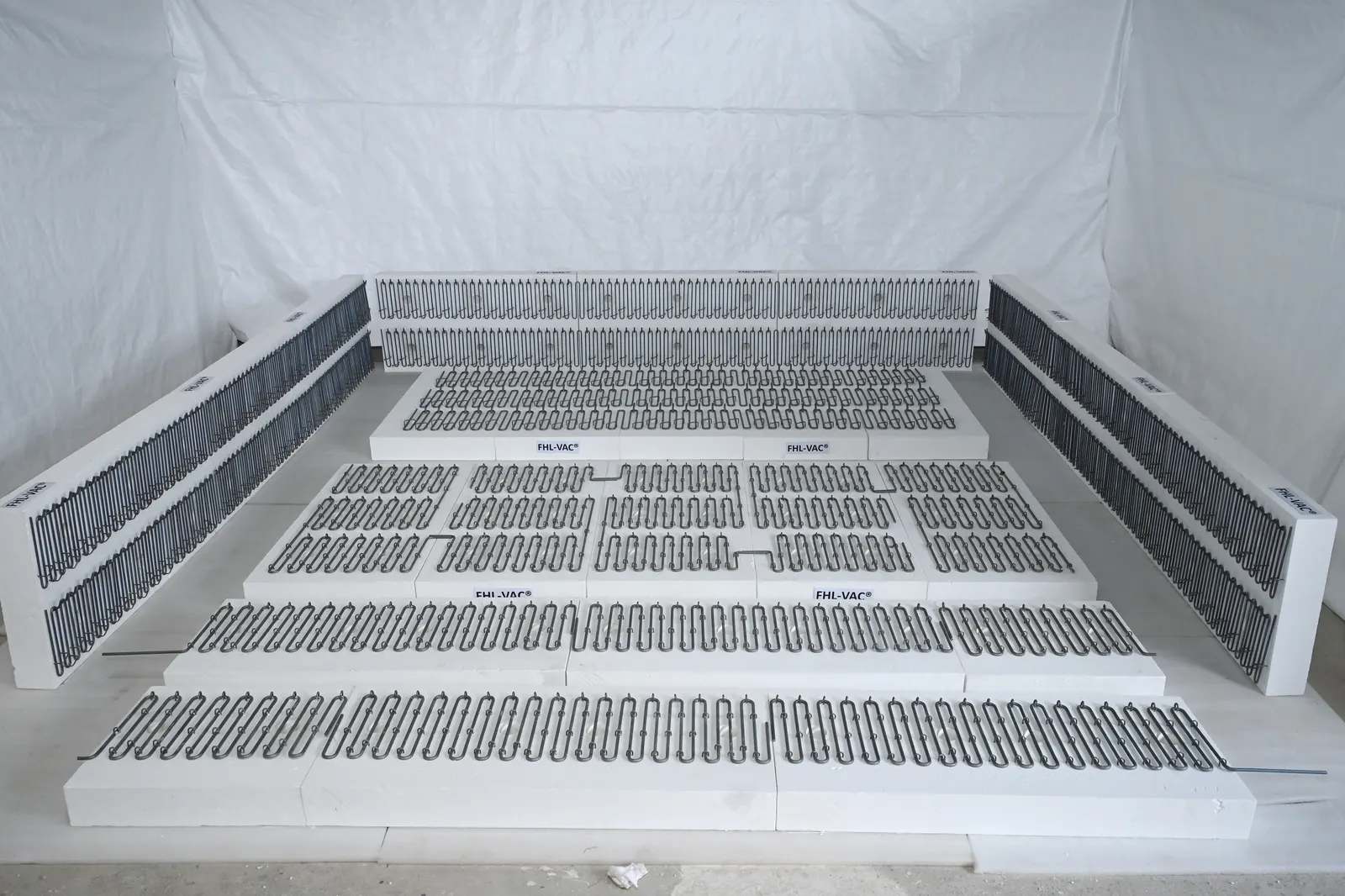
The ceramic fiber vs firebrick question comes up in every furnace relining project, and the answer usually decides the plant's energy bill for the next decade. Dense firebrick has lined industrial furnaces for over a century; vacuum-formed ceramic fiber modules have steadily taken over heat-treatment and batch-furnace duty where cycle time and fuel or power cost dominate. The physics is straightforward. Energy consumed by a furnace lining goes to two places: heat conducted through the wall to the shell, called transmission loss, and heat absorbed by the lining itself on every cycle, called storage loss. Transmission loss depends on thermal conductivity and wall thickness; storage loss depends almost entirely on lining mass. Firebrick is heavy and comparatively conductive; ceramic fiber modules are light and insulating. Everything else in this comparison — heat-up time, shell temperature, cool-down for maintenance, even structural loads — follows from those two properties. The module figures below are real FHL-VAC® datasheet values; the firebrick figures are typical industry ranges, so run your own wall calculation before finalizing the lining specification. The installed-cost side is less one-sided than the energy side, which is why the comparison below separates material, labor, and service-life effects. FeroHeat's relining team models both options against real furnace data — shell-temperature mapping, fuel or power metering, and cycle analysis — so the comparison lands on your tariff rather than generic rules, and the saving usually shows up as a measurable drop in fuel or power per charge.
How much lighter are ceramic fiber modules than firebrick?
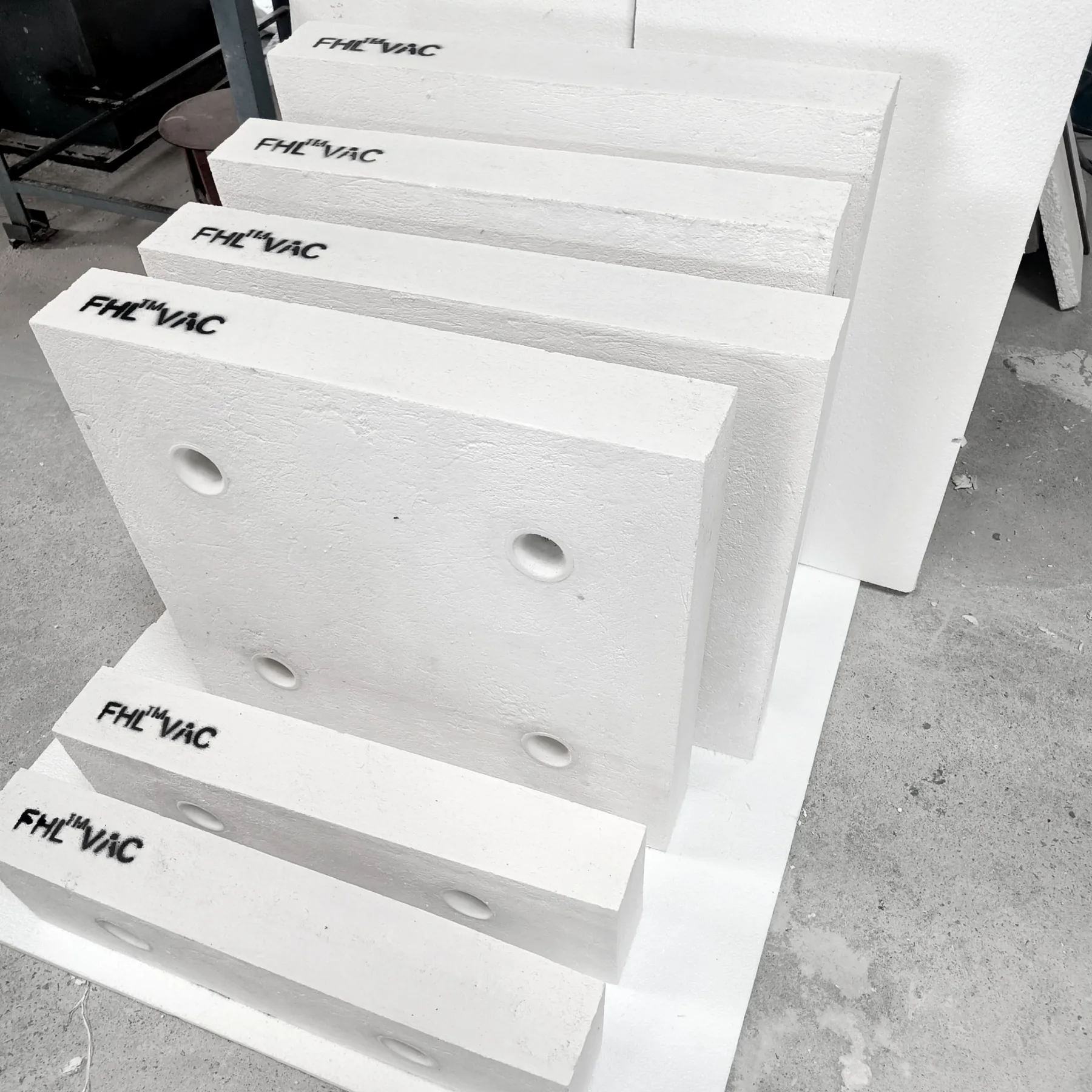
Dense firebrick typically weighs 2,000–2,300 kg/m³; FHL-VAC® modules run at 200–240 kg/m³, roughly one-tenth the mass for a comparable lining thickness. Specific heat per kilogram is similar for both material families, so stored heat scales almost directly with lining mass. In a batch furnace that heats and cools daily, a brick lining absorbs a large share of every firing simply warming itself up, and most of that heat is then dumped to the surroundings when the furnace cools. A module lining reaches working temperature quickly and puts that energy into the load instead — shorter cycles, less overshoot at soak, and cool-down fast enough to support double-shift schedules. Put indicative numbers on it: a 1 m² course of 230 mm dense brickwork typically weighs roughly 480–530 kg, while the same area of 125 mm FHL-VAC® panel weighs about 25–30 kg — and that arithmetic repeats across every square meter of wall and roof. Lighter linings also simplify logistics: a full furnace kit ships in crates a crew can unload without a crane. The mass difference cascades through the whole build. A tenth of the lining weight reduces steelwork and foundation loads, often allowing a reline to reuse the existing structure without reinforcement, and it changes site handling completely: a 950 × 950 mm FHL-VAC® panel is an easy manual lift where the equivalent brick course means cutting, mortar joints, and curing time. Roofs and doors gain the most from the weight saving, because every kilogram removed from a door leaf or roof span reduces bending loads and wear on lifting gear. Faster cool-down after shutdown also means maintenance crews can enter a module-lined furnace hours earlier than a brick-lined one.
Which insulates better at furnace temperatures: ceramic fiber modules or firebrick?
FHL-VAC® Modules vs. Dense Firebrick — Typical Comparison
| Property | FHL-M 1150 | FHL-Z 1325 | FHL-HT 1550 | Dense firebrick (typical) |
|---|---|---|---|---|
| Density (kg/m³) | 200–240 | 200–240 | 200–240 | ≈ 2,000–2,300 |
| Thermal conductivity at 600°C (W/mK) | 0.13 | 0.13 | 0.14 | ≈ 0.9–1.2 |
| Thermal conductivity at 1000°C (W/mK) | 0.27 | 0.28 | 0.24 | ≈ 1.0–1.5 |
| Max. continuous working temperature (°C) | 1150 | 1325 | 1550 | Grade-dependent |
| Linear shrinkage % (24 h at working temp.) | < 1 | < 1 | < 1 | — |
The conductivity gap widens exactly where it matters. At 600°C mean temperature the module grades hold 0.13–0.14 W/mK; at 1000°C they reach 0.24–0.28 W/mK; and even the high-temperature FHL-HT 1550 grade stays at 0.39 W/mK at 1300°C — figures dense firebrick cannot approach. In practice, a thinner module wall achieves the same cold-face temperature as a much thicker brick wall, or the same thickness delivers a cooler, safer shell with lower transmission losses on every hour of the campaign. It also frees working volume inside the chamber, a real gain when retrofitting an older brick furnace whose internal space is fixed by the existing steelwork. Do note that a thinner module wall shifts the temperature gradient through the lining, so verify the cold-face result with a proper heat-flow calculation before finalizing thickness — a cooler shell is also a safer plant to work around and a slower-ageing structure. For continuous furnaces the conductivity term dominates the comparison, because there is no cycle to exploit and the wall loss runs around the clock; for batch furnaces both loss mechanisms stack together. Continuous furnaces gain one further advantage after stoppages: with less lining mass to reheat, the furnace recovers to setpoint faster after a power trip or weekend shutdown. One caveat on reading the table: the fiber values come from FHL-VAC® datasheets, while the firebrick column is a typical industry range that varies with brick grade and manufacturer, so run the wall calculation against the actual brick you are comparing.
When should you still choose firebrick over ceramic fiber modules?
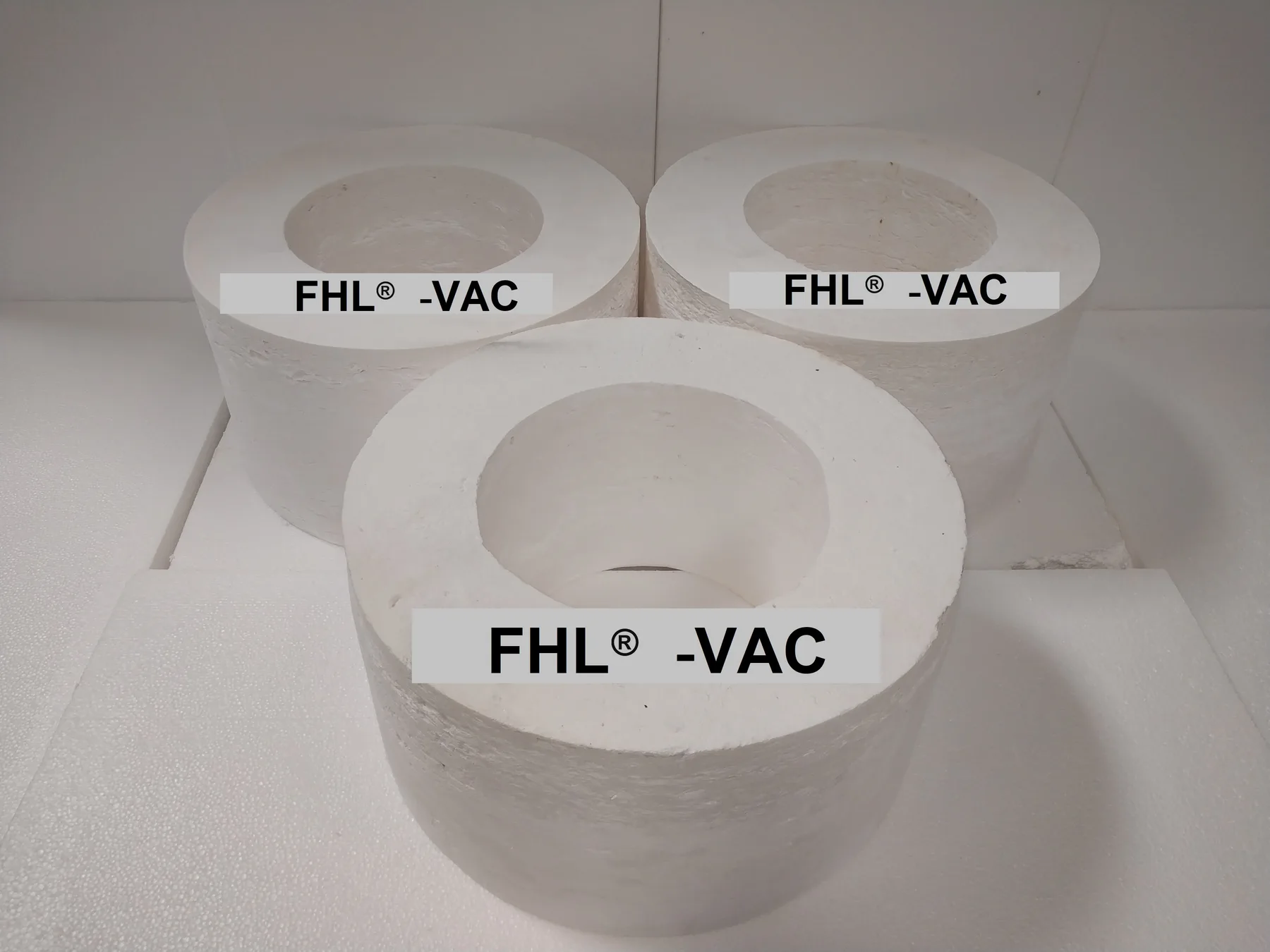
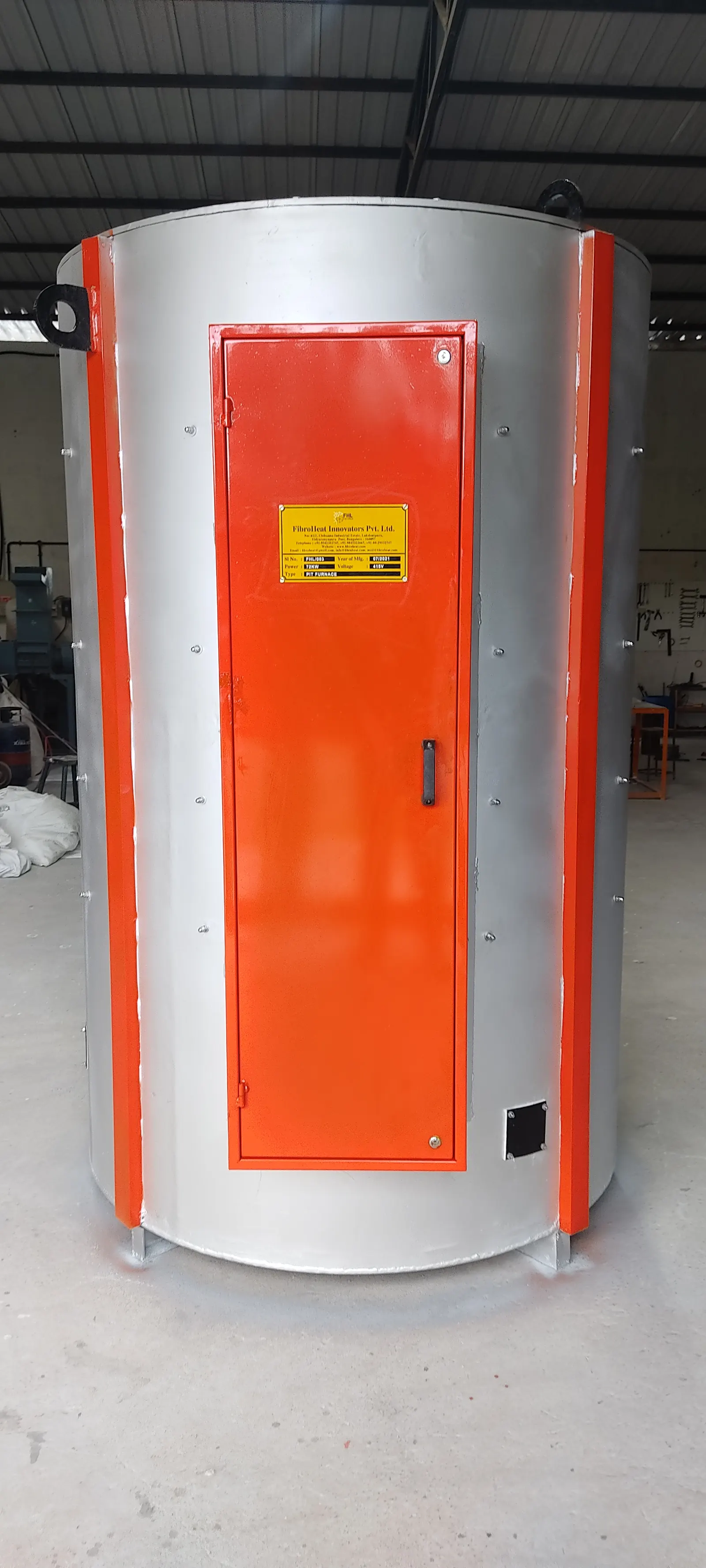
Firebrick remains the right answer where the lining faces mechanical abuse, slag, molten-metal contact, or severe chemical attack: melting-furnace hearths, ladles, launder systems, and high-wear charging zones. It tolerates direct flame impingement better than unprotected fiber and shrugs off careless charging that would gouge a fiber wall. Brick linings are also material-cheap, though labor-heavy: cutting, laying, mortar joints, and long dry-out schedules stretch installation windows in a way modules simply do not — skip the dry-out on a wet lining and you risk steam spalling on first firing, while modules arrive dry and commission on a faster, simpler schedule. Installed cost tells the fuller story. FHL-VAC® flat insulation panels arrive as finished 950 × 950 mm boards and go up quickly with straightforward anchoring, while FHL-VAC® insulation cylinders drop into pit furnaces as complete hot-face liners, so where downtime is expensive the shorter installation window is sometimes worth as much as the energy saving itself. Fiber demands respect in return: avoid mechanical impact, control gas velocity at the hot face, and step up from FHL-M 1150 to FHL-Z 1325 or FHL-HT 1550 as duty temperature rises. Many of the best modern linings are hybrids — brick or castable on floors and impact zones, low-mass modules on the walls and roof, where energy losses are largest and mechanical risk is lowest. In clean heat-treatment duty, well-specified module linings routinely deliver years of service with local patching instead of full relines. FHL-VAC® panels also retrofit roofs and doors particularly well — the areas where brick is hardest to support and where low mass pays twice, once in energy and once in mechanism wear. As a rule of thumb, the more often a furnace cycles between ambient and working temperature, the stronger the case for fiber; run the comparison on your own cycle frequency, energy tariff, and lining mass before committing either way.
How do low-mass modules cut furnace energy costs in practice?
- Faster heat-up: with less lining mass to bring to temperature, batch furnaces reach setpoint sooner — shorter cycles, more batches per shift, and tighter control from the first cycle.
- Lower stored-heat loss at shutdown: heat retained in a heavy brick lining is largely wasted as the furnace cools after every batch.
- Lower transmission loss: 0.24–0.28 W/mK at 1000°C mean temperature keeps heat in the chamber instead of the steel shell — and keeps the casing temperature that safety officers measure comfortably low.
- Faster cool-down for maintenance, cutting the downtime between campaigns and deliveries.
- Lighter structure: about one-tenth of the lining weight reduces steelwork and foundation loads — often the deciding factor in a reline.
- FHL Modular Heating System — asbestos-free fiber keeps installation and repair crews safer during relining work, and clean cool faces reduce the heat load in the shop around the furnace.
- Sealed hot-face option: a coat of FHL® Emiglaze high-emissivity coating over the module surface raises re-radiation to the load and hardens the fiber against erosion.
Key takeaways
- In batch and cyclic furnaces, vacuum-formed ceramic fiber modules usually cut energy costs more than firebrick because stored-heat loss, not transmission loss, dominates the bill.
- FHL-VAC® modules weigh 200–240 kg/m³ — roughly one-tenth of a typical dense firebrick lining at about 2,000–2,300 kg/m³ — so heat stored per cycle falls by a similar factor.
- At a 1000°C mean temperature, FHL-VAC® modules conduct 0.24–0.28 W/mK, several times lower than typical dense firebrick at roughly 1.0–1.5 W/mK.
- Firebrick remains the correct lining for hearths, ladles, and high-wear zones exposed to mechanical abuse, slag, or molten-metal contact.
- Hybrid linings — brick or castable on floors and impact zones, FHL-VAC® modules on walls and roof — capture most of the energy saving at the lowest mechanical risk.
- The faster a furnace cycles between ambient and working temperature, the stronger the economic case for a low-mass ceramic fiber lining.
Frequently asked questions
Is ceramic fiber better than firebrick for furnace lining?
For batch and cyclic furnaces, yes: a 200–240 kg/m³ ceramic fiber module lining stores far less heat than a 2,000-plus kg/m³ brick lining and conducts far less to the shell. Firebrick remains the better material where the lining faces slag, molten metal, or severe mechanical abuse — hearths, ladles, and charging zones.
How much energy can a ceramic fiber lining save compared with brick?
Savings depend on cycle frequency, tariff, and furnace size, so honest figures come from your own numbers — shell-temperature surveys and a fuel- or power-per-charge log before and after relining. In typical batch heat-treatment duty, cutting stored-heat and wall losses with FHL-VAC® modules reduces consumption per cycle by a clearly measurable margin; FeroHeat's energy-audit service quantifies it before you commit.
How much lighter is a ceramic fiber module lining than brick?
About one-tenth. FHL-VAC® modules run 200–240 kg/m³ against roughly 2,000–2,300 kg/m³ for typical dense firebrick, so a module-lined wall weighs a fraction of the brick equivalent — reducing steelwork and foundation loads and making components such as the standard 950 × 950 mm FHL-VAC® boards easy to handle during installation.
Does a ceramic fiber lining last as long as firebrick?
In clean heat-treatment duty it can: module linings routinely deliver years of service, repaired by local patching instead of full relines. The limits are mechanical impact, high gas velocity at the hot face, and exceeding the grade's continuous working temperature. FHL-VAC® grades FHL-M 1150, FHL-Z 1325, and FHL-HT 1550 cover 1150°C, 1325°C, and 1550°C respectively.
Can I replace a brick lining with ceramic fiber modules?
Usually yes — that is a standard FeroHeat relining project. Modules install quickly with straightforward anchoring, need no long dry-out schedule, and the existing steelwork typically carries the lighter lining without reinforcement. Floors and impact zones may stay brick or castable in a hybrid build. Share your drawings and cycle data for a specification and savings estimate.
Written by the FeroHeat Engineering Team. Technically reviewed by Pranesh Kumar, Technical Director.